No. 34 · 29 Sep 2025 · 9 min
TriQ - your training partner for triathlon.
How far away technologies can go in training process?
Hi all,
I hope all of you are doing very, very well. 🙂
Summer is over. 😅
IRONMAN World Championship is over. 🔥
It was one of those rare moments when I was able to watch the race, and it was absolutely amazing to see the Norwegian podium. 🏆
The sports tech industry continues to live a life of its own.
🚨As always, a reminder!
You can hit the Like button.
Leave your Comment.
Share with a friend.
Today I want to share my experience with one of the applications I used while preparing for the Olympic Triathlon Distance. Before we dive in, I’d like to give a bit of context about my overall training experience. Afterwards, I’ll cover the tech side, UX, and athlete perspective. 🙂
This post will be more about my personal experience, and I’ll also share some images from a recent photoshoot I did for one of my friends.
Back in the day, I was interested in sports photography (surprise!), and I finally found some time to go outside with one of the athletes to see what we could create.
What to expect?
Training background
TriQ application and feedback
Training load and preparation
Thoughts
A note from the author
Photoshooting
One of those product studies I made for Train.Red oxygen consumption sensor. Yes, if I associate myself with sports tech, at least I should try things first and not just analyse them. 😅
Training background 🏋️♀️
If you’ve been following me quietly for a while, you should know that I’ve been involved in sports for a long time. I started canoe sprint at the age of 12, and since then, it has simply become a habit for me. I can’t remember a time when I ever stopped training. The only exceptions have been injuries, but even then, if I couldn’t do one activity, I would just switch to something else.
When I was at university, I tried to continue canoe sprint, but I realized it took too much time to commute, and it no longer made sense since I didn’t have the goal of becoming a professional athlete. So I switched to strength training, as well as swimming and other activities to stay active. No pressure, no big goals, just staying in shape.
In 2016, I first learned about IRONMAN races and triathlon, and even thought about participating. That felt like a crazy idea back then because I absolutely hated running. So I came up with a plan: half-marathon first, then marathon, short triathlon distance, Olympic triathlon distance, 70.3 IM, and finally IRONMAN.
No timelines, no roadmap, just an idea in my head.
I knew nothing about running, and at that time we didn’t have nearly as many resources for amateurs as we do today. The good thing was that I had a degree in sports, so at least I knew how to structure training blocks and build a process.
I started preparing for my first half-marathon and completed it after about 4 months from scratch. That was the starting point where I slowly began to enjoy running, and my focus started to shift toward endurance sports.
Last year, I completed a half-marathon in 1:25:48.
Every year I set at least one event I wanted to participate in. Sometimes I changed my goals a few times throughout the year, depending on what I wanted to focus on. When 2025 began, I decided I wanted to go further and break my half-marathon PR of 1:25.
In March, I started rebuilding my aerobic base and focusing completely on running. By the end of June, I began struggling with back pain and leg numbness, and I realized something was wrong. I decided to cut back on running volume. For the next two weeks, I stopped running altogether and focused instead on recovery, mobility, and swimming. That helped reduce the pain and allowed me to return to training without discomfort.
It was also the moment I realized I wanted to complete an Olympic triathlon by the end of September. I had been thinking about it a lot—I needed to stay active, I enjoyed triathlon, and reducing my running volume made sense.
That’s when I started looking for training options, and eventually I found TriQ. After some time using it, I realized I had finally found an application designed specifically for triathlon, with great design and functionality.
TriQ App📲
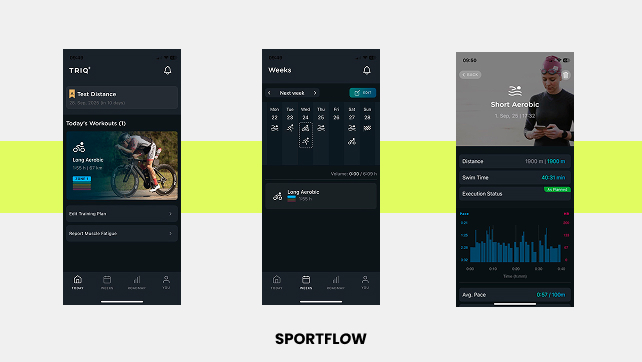
From the very start, I liked the app itself. I don’t like it when very basic and core things are unnecessarily complicated, but this case is completely different. The whole UX/UI experience is clear and intuitive.
During onboarding, you answer a short questionnaire to set your goals, target distance, and availability. By the end, the app generates a personalized plan for you. Nothing groundbreaking, similar to most training apps, but with a clear focus on triathlon.
Talking about features: over the 2.5 months I’ve used the app, I’ve only once had doubts, after being sick and missing 10 days of training in a row.
Other than that, you get everything you need:
Tailored training plan
Weekly plan with each workout explained
Strength training with video guidance
Planned performance tests
Roadmap (visual of the training path leading to your race)
Training adjustments (you can edit the week). The great part is that the app even advises if certain workouts should be avoided due to specific load.
Sick/injury reporting
Analytics
You have a feature to report injuries or days off, and the algorithms rebuild your plan based on your current schedule. However, after 10 full days of active training, it suggested quite a hard swimming session of 2200m (while my average distance in the plan so far was around 1800m). I wasn’t sure about starting such a demanding session right away, so I slightly adapted the training and the following few days based on how I felt. That’s what I continue to repeat: when using AI or any smart device with insights or tips, you should always remember that you know your body best and how it reacts to a certain training load. Yes, sometimes you need to push yourself a bit and train when you’re not fully recovered, but if you’re just coming back from sickness or injury, it’s not a good idea to start with sprint sessions.
Coming back to the app itself, I find a clean and intuitive design a good match for this type of application. Yes, you won’t find something groundbreaking, but if it provides simplicity and focus on the main goal, it’s enough. My overall experience using the app was very positive. I didn’t have any issues with workouts sync or performance overall. The most interesting part about this app so far is that it’s free. Not sure if this is a bug or something wrong, as on Apr 16, 2025, they reported that they are switching to the Paid Subscription. Maybe I’m quite lucky, but I paid nothing.
One thing I like about the application itself, you can check the % of each discipline and analyse your effort. It also counts your past workouts.
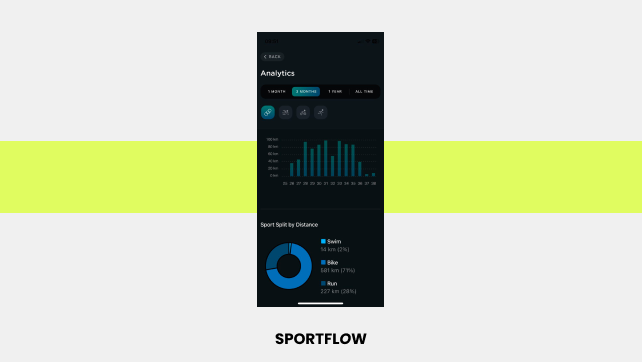
For the last 3 months, I had:
Swim (16km)
Bike (611km)
Run (239km)
Let’s see how you can perform on this volume, being a beginner in cycling. 🙂
Training load and preparation 📈
As you might know, I’ve already shared a bit about my training background. I wasn’t starting completely from scratch. This year, at the beginning of March, I finally bought a bike again (that’s another interesting story). My dream came true once more.
What I really like about the app, and what I find especially useful for beginners, is that it doesn’t throw you into hardcore workouts right away. What do I mean by that?
I’ve used Runna twice in my preparation for a half-marathon. It’s an amazing app for anyone who wants to start running with a tailored training plan. Still, based on my own experience, I often struggled.
Yes, it helped me achieve a PB last year, and it adapts to your sessions and results. But if you’re a beginner and know nothing about training, some workouts might feel too difficult in terms of speed, pace, or workload. Sure, it adapts to your needs. Yes, the plan can be adjusted. And yes, you can always run slower. But for some, even that can be too much. The structure is solid, with smart volume increases, but individual sessions can sometimes feel too demanding.
Of course, without pushing yourself, you won’t get faster, but it also depends on whether your body is actually ready for that load. My main issue with the app was that I tried to follow the plan, workouts, and target paces too closely. Each week, I felt exhausted going into the next one. Even though the volume decreased toward the end of a block, I still felt I couldn’t fully recover from one session to the next.
With TriQ, my experience was completely different.
I had more sessions, five to six per week, but in the first month, I didn’t have a single sprint session on the bike. Instead, it was different variations of aerobic work, focused on duration and cadence.
The same applied to swimming. In the first month, I only did aerobic sessions, increasing the volume each week. Nothing too demanding, just aerobic swims.
Only in running, I had some speed sessions, but nothing too intense, since I already had a solid base in that discipline.
So, in the end, even as I began adding speed sessions across all disciplines, I never felt overtrained by the end of the week. The training volume was there, and I was tired, but my overall fitness still improved little by little. That was a really good feeling.
Thoughts 💬
The initial plan was to complete an Olympic Distance, but at the beginning of September I got sick for 10 days, and during the next two weeks I tried to follow a plan to get back on track. At some point, I realized that I was only adding unnecessary pressure, and in the end, I was right, my body just wasn’t ready. The goal itself shouldn’t be to attempt something impossible just for the sake of it, but to enjoy both the race and the process. I enjoy racing when I feel that I can perform at a certain level.
What I can say is that triathlon is really brutal. Jokes aside. You need to be very structured and consistent to reach a certain level in this sport. I am 100% against the idea of “IRONMAN from the couch in six months.” I recently watched a video where an athlete with solid experience said:
If you’re starting preparation for triathlon, each session, each day, should become as routine as brushing your teeth. You can’t just skip a session because you feel like it. It has to become part of your daily routine without excuses.
I agree with this statement because without structure, you will hurt or injure yourself.
A note from the author ✍️
As a summary, I can say that I was specifically searching for a solution for triathlon, and I found it. If you like a seamless experience, need consistency, and value structure, this is the way to go. I can truly recommend this app without any doubts. It doesn’t matter if you are just starting your journey or are already an experienced athlete; it provides plenty of great tips and advice to make your journey as smooth as possible.
After using this kind of app for a while, I feel that at some point, if you want to progress and improve your results in the long term, a personal coach would be a great choice. We can debate about it, but coaches are still in a strong position. AI won’t replace them, but it can be a powerful tool in their hands.
Photoshooting 📸
I mentioned this at the very beginning, and I’d like to share some of the work I did over the past month, let’s say, a more personal update for all of you. 🙂
Cheers,
Taras ✌️